In this tutorial we will cover the basics in implementing deferred shading using OpenGL 4.0, C++, and GLSL. The code in this tutorial will build on the code from the previous tutorials.
Deferred shading is the process of splitting up traditional rendering into a two-stage system that is designed to improve efficiency in shaders that require complex lighting.
In the first stage we render as usual by using a vertex and pixel shader.
However, the purpose of the pixel shader is entirely different.
We no longer use the pixel shader to do lighting calculations and then output a color to the back buffer.
We instead output information about that pixel (such as normals, texture color, and so forth) to a render to texture buffer.
So now our pixel shader output from the first stage has become a 2D texture full of scene information that can be used as a texture input to the second stage.
In the second stage we re-write all our traditional 3D shaders to now do 2D post processing using the render to texture outputs from the first stage.
And because we are doing 2D post processing we have just a set number of pixels to run our lighting equations on instead of a massive scene full of thousands of complex 3D objects.
Therefore, it no longer matters if we have thousands of lights in our scene or how many polygons are in each object.
We only perform lighting equations on the very final 2D output pixels.
So deferred shading eliminates all sorts of calculations that would be required in the vertex and pixel shader for every single model in the scene.
And all those complex calculations create output data that is usually discarded anyhow due to culling.
So, all those inefficiencies are now eliminated and our shading equations are now a fixed amount of processing regardless of scene size, number of lights, and so forth.
This really opens the door so we can do more complex lighting as well as simplify and combine our shaders that already required 2D post processing.
To proceed we need to first write a deferred shader for the first stage, and then re-write our traditional shaders to take the first stage textures as input and perform 2D post processing.
For simplicity in this tutorial, we will re-write the original directional light shader and show how to connect it to the deferred shader.
Framework
The framework for this tutorial will be similar to the first lighting tutorial.
The two new classes we will add are the DeferredBuffersClass and the DeferredShaderClass.
We will also need to add the OrthoWindowClass since deferred shading requires 2D post processing as part of its rendering process.
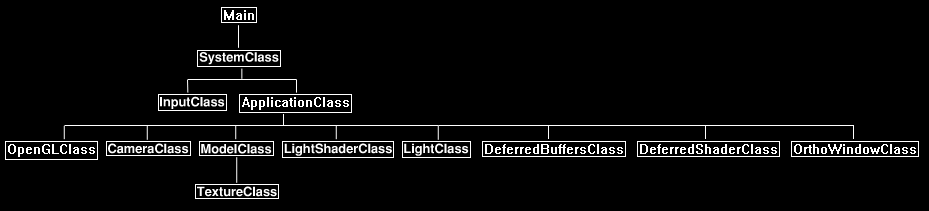
We will start the code section by looking at the new DeferredBuffersClass.
Deferredbuffersclass.h
The DeferredBufferClass is just the render to texture class re-written to handle an array of render to textures instead of just a single one.
The outputs of the deferred shader will be writing to the texture buffers (render targets) of this class.
////////////////////////////////////////////////////////////////////////////////
// Filename: deferredbuffersclass.h
////////////////////////////////////////////////////////////////////////////////
#ifndef _DEFERREDBUFFERSCLASS_H_
#define _DEFERREDBUFFERSCLASS_H_


///////////////////////
// MY CLASS INCLUDES //
///////////////////////
#include "openglclass.h"


////////////////////////////////////////////////////////////////////////////////
// Class name: DeferredBuffersClass
////////////////////////////////////////////////////////////////////////////////
class DeferredBuffersClass
{
public:
    DeferredBuffersClass();
    DeferredBuffersClass(const DeferredBuffersClass&);
    ~DeferredBuffersClass();

    bool Initialize(OpenGLClass*, int, int, float, float);
    void Shutdown(OpenGLClass*);

    void SetRenderTarget(OpenGLClass*);
    void ClearRenderTargets(float, float, float, float);
    void SetTexture(OpenGLClass*, unsigned int, int);

private:
    int m_textureWidth, m_textureHeight;
    unsigned int m_frameBufferId, m_depthBufferId;
The render targets texture IDs are now in an array instead of single values.
    unsigned int m_textureIDArray[2];
};

#endif
Deferredbuffersclass.cpp
////////////////////////////////////////////////////////////////////////////////
// Filename: deferredbuffersclass.cpp
////////////////////////////////////////////////////////////////////////////////
#include "deferredbuffersclass.h"


DeferredBuffersClass::DeferredBuffersClass()
{
}


DeferredBuffersClass::DeferredBuffersClass(const DeferredBuffersClass& other)
{
}


DeferredBuffersClass::~DeferredBuffersClass()
{
}


bool DeferredBuffersClass::Initialize(OpenGLClass* OpenGL, int textureWidth, int textureHeight, float screenNear, float screenDepth)
{
    unsigned int drawBuffersArray[2];


    // Store the width and height of the render texture.
    m_textureWidth = textureWidth;
    m_textureHeight = textureHeight;
There are no code changes to creating the frame buffer, but it will now have a depth buffer and two render texture buffers attached to it.
    // Generate an ID for the frame buffer and bind the frame buffer.
    OpenGL->glGenFramebuffers(1, &m_frameBufferId);
    OpenGL->glBindFramebuffer(GL_FRAMEBUFFER, m_frameBufferId);
The depth buffer is created as normal and attached to the frame buffer.
    // Create the depth buffer and attach it to the frame buffer using GL_DEPTH_ATTACHMENT.
    OpenGL->glGenRenderbuffers(1, &m_depthBufferId);
    OpenGL->glBindRenderbuffer(GL_RENDERBUFFER, m_depthBufferId);
    OpenGL->glRenderbufferStorage(GL_RENDERBUFFER, GL_DEPTH_COMPONENT, m_textureWidth, m_textureHeight);
    OpenGL->glFramebufferRenderbuffer(GL_FRAMEBUFFER, GL_DEPTH_ATTACHMENT, GL_RENDERBUFFER, m_depthBufferId);
The first texture is created here and then attached to the frame buffer using GL_COLOR_ATTACHMENT0.
This texture will be used for rendering the color to.
    // Create the color texture and attach it to the frame buffer using GL_COLOR_ATTACHMENT0.
    OpenGL->glActiveTexture(GL_TEXTURE0 + 0);
    glGenTextures(1, &m_textureIDArray[0]);
    glBindTexture(GL_TEXTURE_2D, m_textureIDArray[0]);
    glTexImage2D(GL_TEXTURE_2D, 0, GL_RGBA, m_textureWidth, m_textureHeight, 0, GL_RGBA, GL_UNSIGNED_BYTE, NULL);  // Color - GL_RGBA
    glTexParameteri(GL_TEXTURE_2D, GL_TEXTURE_MIN_FILTER, GL_NEAREST);  // Requires GL_NEAREST.
    glTexParameteri(GL_TEXTURE_2D, GL_TEXTURE_MAG_FILTER, GL_NEAREST);  // Requires GL_NEAREST.
    glTexParameteri(GL_TEXTURE_2D, GL_TEXTURE_WRAP_S, GL_CLAMP_TO_EDGE);
    glTexParameteri(GL_TEXTURE_2D, GL_TEXTURE_WRAP_T, GL_CLAMP_TO_EDGE);
    OpenGL->glFramebufferTexture2D(GL_FRAMEBUFFER, GL_COLOR_ATTACHMENT0, GL_TEXTURE_2D, m_textureIDArray[0], 0);
The second texture is created here and then attached to the frame buffer using GL_COLOR_ATTACHMENT1.
This texture will be used for rendering the normal values for each pixel.
Note we need to use a larger 32-bit float per channel to represent normal values accurately, otherwise we truncate the range too drastically.
    // Create the normal texture and attach it to the frame buffer using GL_COLOR_ATTACHMENT1.  Normals will require GL_RGBA32F format for third internalformat input.
    OpenGL->glActiveTexture(GL_TEXTURE0 + 0);
    glGenTextures(1, &m_textureIDArray[1]);
    glBindTexture(GL_TEXTURE_2D, m_textureIDArray[1]);
    glTexImage2D(GL_TEXTURE_2D, 0, GL_RGBA32F, m_textureWidth, m_textureHeight, 0, GL_RGBA, GL_FLOAT, NULL);  // Normals - GL_RGBA32F
    glTexParameteri(GL_TEXTURE_2D, GL_TEXTURE_MIN_FILTER, GL_NEAREST);  // Requires GL_NEAREST.
    glTexParameteri(GL_TEXTURE_2D, GL_TEXTURE_MAG_FILTER, GL_NEAREST);  // Requires GL_NEAREST.
    glTexParameteri(GL_TEXTURE_2D, GL_TEXTURE_WRAP_S, GL_CLAMP_TO_EDGE);
    glTexParameteri(GL_TEXTURE_2D, GL_TEXTURE_WRAP_T, GL_CLAMP_TO_EDGE);
    OpenGL->glFramebufferTexture2D(GL_FRAMEBUFFER, GL_COLOR_ATTACHMENT1, GL_TEXTURE_2D, m_textureIDArray[1], 0);
Now we define the pixel shader output here.
Previously we would just output a RGBA color value.
Now we output a vec4 color value and a vec4 normal value.
One efficiency in deferred rendering comes from being able to render to multiple targets in the same pass.
    // Now set the format for the pixel shader output when rendering with this frame buffer.
    drawBuffersArray[0] = GL_COLOR_ATTACHMENT0;
    drawBuffersArray[1] = GL_COLOR_ATTACHMENT1;
    OpenGL->glDrawBuffers(2, drawBuffersArray);

    // Now that we are done setting up the render texture frame buffer, we can switch back to the regular back buffer that is used for rendering.
    OpenGL->glBindFramebuffer(GL_FRAMEBUFFER, 0);

    return true;
}


void DeferredBuffersClass::Shutdown(OpenGLClass* OpenGL)
{
    // Release the depth buffer.
    OpenGL->glDeleteRenderbuffers(1, &m_depthBufferId);
We now release two textures (color and normal).
    // Release the textures.
    glDeleteTextures(1, &m_textureIDArray[0]);
    glDeleteTextures(1, &m_textureIDArray[1]);

    // Release the frame buffer.
    OpenGL->glDeleteFramebuffers(1, &m_frameBufferId);

    return;
}


void DeferredBuffersClass::SetRenderTarget(OpenGLClass* OpenGL)
{
There are no changes to SetRenderTarget code, but when we bind the frame buffer it will now bind the depth buffer, the color texture, and the normal texture.
    // Set the frame buffer (and its attached textures and depth buffer) as the render target.
    OpenGL->glBindFramebuffer(GL_FRAMEBUFFER, m_frameBufferId);

    // Set the viewport to be the correct dimensions for the texture dimensions used.
    glViewport(0, 0, m_textureWidth, m_textureHeight);

    return;
}


void DeferredBuffersClass::ClearRenderTargets(float red, float green, float blue, float alpha)
{
    // Clear the back buffer.
    glClearColor(red, green, blue, alpha);

    // Clear the depth buffer.
    glClear(GL_COLOR_BUFFER_BIT | GL_DEPTH_BUFFER_BIT);

    return;
}
The SetTexture function now allows us to set which of the individual textures we want that are encapsulated in the DefferedBuffersClass.
void DeferredBuffersClass::SetTexture(OpenGLClass* OpenGL, unsigned int textureUnit, int view)
{
    // Set the texture unit we are working with.
    OpenGL->glActiveTexture(GL_TEXTURE0 + textureUnit);

    // Bind the texture as a 2D texture.
    glBindTexture(GL_TEXTURE_2D, m_textureIDArray[view]);

    return;
}
Deferred.vs
These are our deferred GLSL shaders.
We use these to render the scene data into render to texture buffers.
For the deferred vertex shader, it still does the exact same thing as in previous tutorials.
All the changes are actually in the pixel shader.
////////////////////////////////////////////////////////////////////////////////
// Filename: deferred.vs
////////////////////////////////////////////////////////////////////////////////
#version 400


/////////////////////
// INPUT VARIABLES //
/////////////////////
in vec3 inputPosition;
in vec2 inputTexCoord;
in vec3 inputNormal;


//////////////////////
// OUTPUT VARIABLES //
//////////////////////
out vec2 texCoord;
out vec3 normal;


///////////////////////
// UNIFORM VARIABLES //
///////////////////////
uniform mat4 worldMatrix;
uniform mat4 viewMatrix;
uniform mat4 projectionMatrix;


////////////////////////////////////////////////////////////////////////////////
// Vertex Shader
////////////////////////////////////////////////////////////////////////////////
void main(void)
{
    // Calculate the position of the vertex against the world, view, and projection matrices.
    gl_Position = vec4(inputPosition, 1.0f) * worldMatrix;
    gl_Position = gl_Position * viewMatrix;
    gl_Position = gl_Position * projectionMatrix;

    // Store the texture coordinates for the pixel shader.
    texCoord = inputTexCoord;

    // Calculate the normal vector against the world matrix only.
    normal = inputNormal * mat3(worldMatrix);

    // Normalize the normal vector.
    normal = normalize(normal);
}
Deferred.ps
////////////////////////////////////////////////////////////////////////////////
// Filename: deferred.ps
////////////////////////////////////////////////////////////////////////////////
#version 400


/////////////////////
// INPUT VARIABLES //
/////////////////////
in vec2 texCoord;
in vec3 normal;
We have a new output format for the pixel shader output.
This will output color data to the first render texture target, and normals to the second render texture target.
//////////////////////
// OUTPUT VARIABLES //
//////////////////////
out vec4 outputColor;
out vec4 outputNormal;


///////////////////////
// UNIFORM VARIABLES //
///////////////////////
uniform sampler2D shaderTexture;
The pixel shader now uses a different output type that we defined above instead of just outputting a single color value.
It will now write to the two render targets.
We send the color texture pixel to the first render target, and we send the normals to the second render target.
The two textures that are output from this shader will then be used as the input data for all of our new re-written shaders.
////////////////////////////////////////////////////////////////////////////////
// Pixel Shader
////////////////////////////////////////////////////////////////////////////////
void main(void)
{
    // Sample the color from the texture and store it for output to the deferred render target.
    outputColor = texture(shaderTexture, texCoord);

    // Store the normal for output to the deferred render target.
    outputNormal = vec4(normal, 1.0f);
}
Deferredshaderclass.h
This is the class that encapsulates the functionality of the deferred shader.
It doesn't vary much from the regular shaders.
////////////////////////////////////////////////////////////////////////////////
// Filename: deferredshaderclass.h
////////////////////////////////////////////////////////////////////////////////
#ifndef _DEFERREDSHADERCLASS_H_
#define _DEFERREDSHADERCLASS_H_


//////////////
// INCLUDES //
//////////////
#include <iostream>
using namespace std;


///////////////////////
// MY CLASS INCLUDES //
///////////////////////
#include "openglclass.h"


////////////////////////////////////////////////////////////////////////////////
// Class name: DeferredShaderClass
////////////////////////////////////////////////////////////////////////////////
class DeferredShaderClass
{
public:
    DeferredShaderClass();
    DeferredShaderClass(const DeferredShaderClass&);
    ~DeferredShaderClass();

    bool Initialize(OpenGLClass*);
    void Shutdown();

    bool SetShaderParameters(float*, float*, float*);

private:
    bool InitializeShader(char*, char*);
    void ShutdownShader();
    char* LoadShaderSourceFile(char*);
    void OutputShaderErrorMessage(unsigned int, char*);
    void OutputLinkerErrorMessage(unsigned int);

private:
    OpenGLClass* m_OpenGLPtr;
    unsigned int m_vertexShader;
    unsigned int m_fragmentShader;
    unsigned int m_shaderProgram;
};

#endif
Deferredshaderclass.cpp
////////////////////////////////////////////////////////////////////////////////
// Filename: deferredshaderclass.cpp
////////////////////////////////////////////////////////////////////////////////
#include "deferredshaderclass.h"


DeferredShaderClass::DeferredShaderClass()
{
    m_OpenGLPtr = 0;
}


DeferredShaderClass::DeferredShaderClass(const DeferredShaderClass& other)
{
}


DeferredShaderClass::~DeferredShaderClass()
{
}


bool DeferredShaderClass::Initialize(OpenGLClass* OpenGL)
{
    char vsFilename[128];
    char psFilename[128];
    bool result;


    // Store the pointer to the OpenGL object.
    m_OpenGLPtr = OpenGL;
Load the deferred vertex and pixel GLSL shader files.
    // Set the location and names of the shader files.
    strcpy(vsFilename, "../Engine/deferred.vs");
    strcpy(psFilename, "../Engine/deferred.ps");

    // Initialize the vertex and pixel shaders.
    result = InitializeShader(vsFilename, psFilename);
    if(!result)
    {
        return false;
    }

    return true;
}


void DeferredShaderClass::Shutdown()
{
    // Shutdown the shader.
    ShutdownShader();

    // Release the pointer to the OpenGL object.
    m_OpenGLPtr = 0;

    return;
}


bool DeferredShaderClass::InitializeShader(char* vsFilename, char* fsFilename)
{
    const char* vertexShaderBuffer;
    const char* fragmentShaderBuffer;
    int status;


    // Load the vertex shader source file into a text buffer.
    vertexShaderBuffer = LoadShaderSourceFile(vsFilename);
    if(!vertexShaderBuffer)
    {
        return false;
    }

    // Load the fragment shader source file into a text buffer.
    fragmentShaderBuffer = LoadShaderSourceFile(fsFilename);
    if(!fragmentShaderBuffer)
    {
        return false;
    }

    // Create a vertex and fragment shader object.
    m_vertexShader = m_OpenGLPtr->glCreateShader(GL_VERTEX_SHADER);
    m_fragmentShader = m_OpenGLPtr->glCreateShader(GL_FRAGMENT_SHADER);

    // Copy the shader source code strings into the vertex and fragment shader objects.
    m_OpenGLPtr->glShaderSource(m_vertexShader, 1, &vertexShaderBuffer, NULL);
    m_OpenGLPtr->glShaderSource(m_fragmentShader, 1, &fragmentShaderBuffer, NULL);

    // Release the vertex and fragment shader buffers.
    delete [] vertexShaderBuffer;
    vertexShaderBuffer = 0;

    delete [] fragmentShaderBuffer;
    fragmentShaderBuffer = 0;

    // Compile the shaders.
    m_OpenGLPtr->glCompileShader(m_vertexShader);
    m_OpenGLPtr->glCompileShader(m_fragmentShader);

    // Check to see if the vertex shader compiled successfully.
    m_OpenGLPtr->glGetShaderiv(m_vertexShader, GL_COMPILE_STATUS, &status);
    if(status != 1)
    {
        // If it did not compile then write the syntax error message out to a text file for review.
        OutputShaderErrorMessage(m_vertexShader, vsFilename);
        return false;
    }

    // Check to see if the fragment shader compiled successfully.
    m_OpenGLPtr->glGetShaderiv(m_fragmentShader, GL_COMPILE_STATUS, &status);
    if(status != 1)
    {
        // If it did not compile then write the syntax error message out to a text file for review.
        OutputShaderErrorMessage(m_fragmentShader, fsFilename);
        return false;
    }

    // Create a shader program object.
    m_shaderProgram = m_OpenGLPtr->glCreateProgram();

    // Attach the vertex and fragment shader to the program object.
    m_OpenGLPtr->glAttachShader(m_shaderProgram, m_vertexShader);
    m_OpenGLPtr->glAttachShader(m_shaderProgram, m_fragmentShader);

    // Bind the shader input variables.
    m_OpenGLPtr->glBindAttribLocation(m_shaderProgram, 0, "inputPosition");
    m_OpenGLPtr->glBindAttribLocation(m_shaderProgram, 1, "inputTexCoord");
    m_OpenGLPtr->glBindAttribLocation(m_shaderProgram, 2, "inputNormal");

    // Link the shader program.
    m_OpenGLPtr->glLinkProgram(m_shaderProgram);

    // Check the status of the link.
    m_OpenGLPtr->glGetProgramiv(m_shaderProgram, GL_LINK_STATUS, &status);
    if(status != 1)
    {
        // If it did not link then write the syntax error message out to a text file for review.
        OutputLinkerErrorMessage(m_shaderProgram);
        return false;
    }

    return true;
}


void DeferredShaderClass::ShutdownShader()
{
    // Detach the vertex and fragment shaders from the program.
    m_OpenGLPtr->glDetachShader(m_shaderProgram, m_vertexShader);
    m_OpenGLPtr->glDetachShader(m_shaderProgram, m_fragmentShader);

    // Delete the vertex and fragment shaders.
    m_OpenGLPtr->glDeleteShader(m_vertexShader);
    m_OpenGLPtr->glDeleteShader(m_fragmentShader);

    // Delete the shader program.
    m_OpenGLPtr->glDeleteProgram(m_shaderProgram);

    return;
}


char* DeferredShaderClass::LoadShaderSourceFile(char* filename)
{
    FILE* filePtr;
    char* buffer;
    long fileSize, count;
    int error;


    // Open the shader file for reading in text modee.
    filePtr = fopen(filename, "r");
    if(filePtr == NULL)
    {
        return 0;
    }

    // Go to the end of the file and get the size of the file.
    fseek(filePtr, 0, SEEK_END);
    fileSize = ftell(filePtr);

    // Initialize the buffer to read the shader source file into, adding 1 for an extra null terminator.
    buffer = new char[fileSize + 1];

    // Return the file pointer back to the beginning of the file.
    fseek(filePtr, 0, SEEK_SET);

    // Read the shader text file into the buffer.
    count = fread(buffer, 1, fileSize, filePtr);
    if(count != fileSize)
    {
        return 0;
    }

    // Close the file.
    error = fclose(filePtr);
    if(error != 0)
    {
        return 0;
    }

    // Null terminate the buffer.
    buffer[fileSize] = '\0';

    return buffer;
}


void DeferredShaderClass::OutputShaderErrorMessage(unsigned int shaderId, char* shaderFilename)
{
    long count;
    int logSize, error;
    char* infoLog;
    FILE* filePtr;


    // Get the size of the string containing the information log for the failed shader compilation message.
    m_OpenGLPtr->glGetShaderiv(shaderId, GL_INFO_LOG_LENGTH, &logSize);

    // Increment the size by one to handle also the null terminator.
    logSize++;

    // Create a char buffer to hold the info log.
    infoLog = new char[logSize];

    // Now retrieve the info log.
    m_OpenGLPtr->glGetShaderInfoLog(shaderId, logSize, NULL, infoLog);

    // Open a text file to write the error message to.
    filePtr = fopen("shader-error.txt", "w");
    if(filePtr == NULL)
    {
        cout << "Error opening shader error message output file." << endl;
        return;
    }

    // Write out the error message.
    count = fwrite(infoLog, sizeof(char), logSize, filePtr);
    if(count != logSize)
    {
        cout << "Error writing shader error message output file." << endl;
        return;
    }

    // Close the file.
    error = fclose(filePtr);
    if(error != 0)
    {
        cout << "Error closing shader error message output file." << endl;
        return;
    }

    // Notify the user to check the text file for compile errors.
    cout << "Error compiling shader.  Check shader-error.txt for error message.  Shader filename: " << shaderFilename << endl;

    return;
}


void DeferredShaderClass::OutputLinkerErrorMessage(unsigned int programId)
{
    long count;
    FILE* filePtr;
    int logSize, error;
    char* infoLog;


    // Get the size of the string containing the information log for the failed shader compilation message.
    m_OpenGLPtr->glGetProgramiv(programId, GL_INFO_LOG_LENGTH, &logSize);

    // Increment the size by one to handle also the null terminator.
    logSize++;

    // Create a char buffer to hold the info log.
    infoLog = new char[logSize];

    // Now retrieve the info log.
    m_OpenGLPtr->glGetProgramInfoLog(programId, logSize, NULL, infoLog);

    // Open a file to write the error message to.
    filePtr = fopen("linker-error.txt", "w");
    if(filePtr == NULL)
    {
        cout << "Error opening linker error message output file." << endl;
        return;
    }

    // Write out the error message.
    count = fwrite(infoLog, sizeof(char), logSize, filePtr);
    if(count != logSize)
    {
        cout << "Error writing linker error message output file." << endl;
        return;
    }

    // Close the file.
    error = fclose(filePtr);
    if(error != 0)
    {
        cout << "Error closing linker error message output file." << endl;
        return;
    }

    // Pop a message up on the screen to notify the user to check the text file for linker errors.
    cout << "Error linking shader program.  Check linker-error.txt for message." << endl;

    return;
}


bool DeferredShaderClass::SetShaderParameters(float* worldMatrix, float* viewMatrix, float* projectionMatrix)
{
    float tpWorldMatrix[16], tpViewMatrix[16], tpProjectionMatrix[16];
    int location;


    // Transpose the matrices to prepare them for the shader.
    m_OpenGLPtr->MatrixTranspose(tpWorldMatrix, worldMatrix);
    m_OpenGLPtr->MatrixTranspose(tpViewMatrix, viewMatrix);
    m_OpenGLPtr->MatrixTranspose(tpProjectionMatrix, projectionMatrix);

    // Install the shader program as part of the current rendering state.
    m_OpenGLPtr->glUseProgram(m_shaderProgram);

    // Set the world matrix in the vertex shader.
    location = m_OpenGLPtr->glGetUniformLocation(m_shaderProgram, "worldMatrix");
    if(location == -1)
    {
        cout << "World matrix not set." << endl;
    }
    m_OpenGLPtr ->glUniformMatrix4fv(location, 1, false, tpWorldMatrix);

    // Set the view matrix in the vertex shader.
    location = m_OpenGLPtr->glGetUniformLocation(m_shaderProgram, "viewMatrix");
    if(location == -1)
    {
        cout << "View matrix not set." << endl;
    }
    m_OpenGLPtr->glUniformMatrix4fv(location, 1, false, tpViewMatrix);

    // Set the projection matrix in the vertex shader.
    location = m_OpenGLPtr->glGetUniformLocation(m_shaderProgram, "projectionMatrix");
    if(location == -1)
    {
        cout << "Projection matrix not set." << endl;
    }
    m_OpenGLPtr->glUniformMatrix4fv(location, 1, false, tpProjectionMatrix);

    // Set the texture in the pixel shader to use the data from the first texture unit.
    location = m_OpenGLPtr->glGetUniformLocation(m_shaderProgram, "shaderTexture");
    if(location == -1)
    {
        cout << "Shader texture not set." << endl;
    }
    m_OpenGLPtr->glUniform1i(location, 0);

    return true;
}
Light.vs
This is the directional light shader that has been re-written to handle deferred rendering.
////////////////////////////////////////////////////////////////////////////////
// Filename: light.vs
////////////////////////////////////////////////////////////////////////////////
#version 400
In deferred shaders, we don't require normals as input vectors since the normal data is in the render texture and we are only doing 2D post processing here.
/////////////////////
// INPUT VARIABLES //
/////////////////////
in vec3 inputPosition;
in vec2 inputTexCoord;


//////////////////////
// OUTPUT VARIABLES //
//////////////////////
out vec2 texCoord;


///////////////////////
// UNIFORM VARIABLES //
///////////////////////
uniform mat4 worldMatrix;
uniform mat4 viewMatrix;
uniform mat4 projectionMatrix;
The vertex shader will just forward the position and texture coordinates of the 2D image that we are processing.
////////////////////////////////////////////////////////////////////////////////
// Vertex Shader
////////////////////////////////////////////////////////////////////////////////
void main(void)
{
    // Calculate the position of the vertex against the world, view, and projection matrices.
    gl_Position = vec4(inputPosition, 1.0f) * worldMatrix;
    gl_Position = gl_Position * viewMatrix;
    gl_Position = gl_Position * projectionMatrix;

    // Store the texture coordinates for the pixel shader.
    texCoord = inputTexCoord;
}
Light.ps
////////////////////////////////////////////////////////////////////////////////
// Filename: light.ps
////////////////////////////////////////////////////////////////////////////////
#version 400


/////////////////////
// INPUT VARIABLES //
/////////////////////
in vec2 texCoord;


//////////////////////
// OUTPUT VARIABLES //
//////////////////////
out vec4 outputColor;
As inputs the deferred light shader takes the two render textures that contain the color information and the normals from the deferred shader.
///////////////////////
// UNIFORM VARIABLES //
///////////////////////
uniform sampler2D colorTexture;
uniform sampler2D normalTexture;
uniform vec3 lightDirection;


////////////////////////////////////////////////////////////////////////////////
// Pixel Shader
////////////////////////////////////////////////////////////////////////////////
void main(void)
{
    vec4 colors;
    vec4 normals;
    vec3 lightDir;
    float lightIntensity;
In the light pixel shader, we start by retrieving the color data and normals for this pixel using the point sampler.
    // Sample the pixel color from the texture using the sampler at this texture coordinate location.
    colors = texture(colorTexture, texCoord);

    // Sample the normals from the normal render texture using the point sampler at this texture coordinate location.
    normals = texture(normalTexture, texCoord);
We can then perform our directional lighting equation using this sampled information.
    // Invert the light direction for calculations.
    lightDir = -lightDirection;

    // Calculate the amount of light on this pixel.
    lightIntensity = clamp(dot(normals.xyz, lightDir), 0.0f, 1.0f);

    // Determine the final amount of diffuse color based on the color of the pixel combined with the light intensity.
    outputColor = clamp(colors * lightIntensity, 0.0f, 1.0f);
}
Lightshaderclass.h
The LightShaderClass has been re-written to handle deferred shading.
////////////////////////////////////////////////////////////////////////////////
// Filename: lightshaderclass.h
////////////////////////////////////////////////////////////////////////////////
#ifndef _LIGHTSHADERCLASS_H_
#define _LIGHTSHADERCLASS_H_


//////////////
// INCLUDES //
//////////////
#include <iostream>
using namespace std;


///////////////////////
// MY CLASS INCLUDES //
///////////////////////
#include "openglclass.h"


////////////////////////////////////////////////////////////////////////////////
// Class name: LightShaderClass
////////////////////////////////////////////////////////////////////////////////
class LightShaderClass
{
public:
    LightShaderClass();
    LightShaderClass(const LightShaderClass&);
    ~LightShaderClass();

    bool Initialize(OpenGLClass*);
    void Shutdown();

    bool SetShaderParameters(float*, float*, float*, float*);

private:
    bool InitializeShader(char*, char*);
    void ShutdownShader();
    char* LoadShaderSourceFile(char*);
    void OutputShaderErrorMessage(unsigned int, char*);
    void OutputLinkerErrorMessage(unsigned int);

private:
    OpenGLClass* m_OpenGLPtr;
    unsigned int m_vertexShader;
    unsigned int m_fragmentShader;
    unsigned int m_shaderProgram;
};

#endif
Lightshaderclass.cpp
////////////////////////////////////////////////////////////////////////////////
// Filename: lightshaderclass.cpp
////////////////////////////////////////////////////////////////////////////////
#include "lightshaderclass.h"


LightShaderClass::LightShaderClass()
{
    m_OpenGLPtr = 0;
}


LightShaderClass::LightShaderClass(const LightShaderClass& other)
{
}


LightShaderClass::~LightShaderClass()
{
}


bool LightShaderClass::Initialize(OpenGLClass* OpenGL)
{
    char vsFilename[128];
    char psFilename[128];
    bool result;


    // Store the pointer to the OpenGL object.
    m_OpenGLPtr = OpenGL;

    // Set the location and names of the shader files.
    strcpy(vsFilename, "../Engine/light.vs");
    strcpy(psFilename, "../Engine/light.ps");

    // Initialize the vertex and pixel shaders.
    result = InitializeShader(vsFilename, psFilename);
    if(!result)
    {
        return false;
    }

    return true;
}


void LightShaderClass::Shutdown()
{
    // Shutdown the shader.
    ShutdownShader();

    // Release the pointer to the OpenGL object.
    m_OpenGLPtr = 0;

    return;
}


bool LightShaderClass::InitializeShader(char* vsFilename, char* fsFilename)
{
    const char* vertexShaderBuffer;
    const char* fragmentShaderBuffer;
    int status;


    // Load the vertex shader source file into a text buffer.
    vertexShaderBuffer = LoadShaderSourceFile(vsFilename);
    if(!vertexShaderBuffer)
    {
        return false;
    }

    // Load the fragment shader source file into a text buffer.
    fragmentShaderBuffer = LoadShaderSourceFile(fsFilename);
    if(!fragmentShaderBuffer)
    {
        return false;
    }

    // Create a vertex and fragment shader object.
    m_vertexShader = m_OpenGLPtr->glCreateShader(GL_VERTEX_SHADER);
    m_fragmentShader = m_OpenGLPtr->glCreateShader(GL_FRAGMENT_SHADER);

    // Copy the shader source code strings into the vertex and fragment shader objects.
    m_OpenGLPtr->glShaderSource(m_vertexShader, 1, &vertexShaderBuffer, NULL);
    m_OpenGLPtr->glShaderSource(m_fragmentShader, 1, &fragmentShaderBuffer, NULL);

    // Release the vertex and fragment shader buffers.
    delete [] vertexShaderBuffer;
    vertexShaderBuffer = 0;

    delete [] fragmentShaderBuffer;
    fragmentShaderBuffer = 0;

    // Compile the shaders.
    m_OpenGLPtr->glCompileShader(m_vertexShader);
    m_OpenGLPtr->glCompileShader(m_fragmentShader);

    // Check to see if the vertex shader compiled successfully.
    m_OpenGLPtr->glGetShaderiv(m_vertexShader, GL_COMPILE_STATUS, &status);
    if(status != 1)
    {
        // If it did not compile then write the syntax error message out to a text file for review.
        OutputShaderErrorMessage(m_vertexShader, vsFilename);
        return false;
    }

    // Check to see if the fragment shader compiled successfully.
    m_OpenGLPtr->glGetShaderiv(m_fragmentShader, GL_COMPILE_STATUS, &status);
    if(status != 1)
    {
        // If it did not compile then write the syntax error message out to a text file for review.
        OutputShaderErrorMessage(m_fragmentShader, fsFilename);
        return false;
    }

    // Create a shader program object.
    m_shaderProgram = m_OpenGLPtr->glCreateProgram();

    // Attach the vertex and fragment shader to the program object.
    m_OpenGLPtr->glAttachShader(m_shaderProgram, m_vertexShader);
    m_OpenGLPtr->glAttachShader(m_shaderProgram, m_fragmentShader);
The polygon layout now only requires position and texture coordinates since we are doing 2D post processing.
    // Bind the shader input variables.
    m_OpenGLPtr->glBindAttribLocation(m_shaderProgram, 0, "inputPosition");
    m_OpenGLPtr->glBindAttribLocation(m_shaderProgram, 1, "inputTexCoord");

    // Link the shader program.
    m_OpenGLPtr->glLinkProgram(m_shaderProgram);

    // Check the status of the link.
    m_OpenGLPtr->glGetProgramiv(m_shaderProgram, GL_LINK_STATUS, &status);
    if(status != 1)
    {
        // If it did not link then write the syntax error message out to a text file for review.
        OutputLinkerErrorMessage(m_shaderProgram);
        return false;
    }

    return true;
}


void LightShaderClass::ShutdownShader()
{
    // Detach the vertex and fragment shaders from the program.
    m_OpenGLPtr->glDetachShader(m_shaderProgram, m_vertexShader);
    m_OpenGLPtr->glDetachShader(m_shaderProgram, m_fragmentShader);

    // Delete the vertex and fragment shaders.
    m_OpenGLPtr->glDeleteShader(m_vertexShader);
    m_OpenGLPtr->glDeleteShader(m_fragmentShader);

    // Delete the shader program.
    m_OpenGLPtr->glDeleteProgram(m_shaderProgram);

    return;
}


char* LightShaderClass::LoadShaderSourceFile(char* filename)
{
    FILE* filePtr;
    char* buffer;
    long fileSize, count;
    int error;


    // Open the shader file for reading in text modee.
    filePtr = fopen(filename, "r");
    if(filePtr == NULL)
    {
        return 0;
    }

    // Go to the end of the file and get the size of the file.
    fseek(filePtr, 0, SEEK_END);
    fileSize = ftell(filePtr);

    // Initialize the buffer to read the shader source file into, adding 1 for an extra null terminator.
    buffer = new char[fileSize + 1];

    // Return the file pointer back to the beginning of the file.
    fseek(filePtr, 0, SEEK_SET);

    // Read the shader text file into the buffer.
    count = fread(buffer, 1, fileSize, filePtr);
    if(count != fileSize)
    {
        return 0;
    }

    // Close the file.
    error = fclose(filePtr);
    if(error != 0)
    {
        return 0;
    }

    // Null terminate the buffer.
    buffer[fileSize] = '\0';

    return buffer;
}


void LightShaderClass::OutputShaderErrorMessage(unsigned int shaderId, char* shaderFilename)
{
    long count;
    int logSize, error;
    char* infoLog;
    FILE* filePtr;


    // Get the size of the string containing the information log for the failed shader compilation message.
    m_OpenGLPtr->glGetShaderiv(shaderId, GL_INFO_LOG_LENGTH, &logSize);

    // Increment the size by one to handle also the null terminator.
    logSize++;

    // Create a char buffer to hold the info log.
    infoLog = new char[logSize];

    // Now retrieve the info log.
    m_OpenGLPtr->glGetShaderInfoLog(shaderId, logSize, NULL, infoLog);

    // Open a text file to write the error message to.
    filePtr = fopen("shader-error.txt", "w");
    if(filePtr == NULL)
    {
        cout << "Error opening shader error message output file." << endl;
        return;
    }

    // Write out the error message.
    count = fwrite(infoLog, sizeof(char), logSize, filePtr);
    if(count != logSize)
    {
        cout << "Error writing shader error message output file." << endl;
        return;
    }

    // Close the file.
    error = fclose(filePtr);
    if(error != 0)
    {
        cout << "Error closing shader error message output file." << endl;
        return;
    }

    // Notify the user to check the text file for compile errors.
    cout << "Error compiling shader.  Check shader-error.txt for error message.  Shader filename: " << shaderFilename << endl;

    return;
}


void LightShaderClass::OutputLinkerErrorMessage(unsigned int programId)
{
    long count;
    FILE* filePtr;
    int logSize, error;
    char* infoLog;


    // Get the size of the string containing the information log for the failed shader compilation message.
    m_OpenGLPtr->glGetProgramiv(programId, GL_INFO_LOG_LENGTH, &logSize);

    // Increment the size by one to handle also the null terminator.
    logSize++;

    // Create a char buffer to hold the info log.
    infoLog = new char[logSize];

    // Now retrieve the info log.
    m_OpenGLPtr->glGetProgramInfoLog(programId, logSize, NULL, infoLog);

    // Open a file to write the error message to.
    filePtr = fopen("linker-error.txt", "w");
    if(filePtr == NULL)
    {
        cout << "Error opening linker error message output file." << endl;
        return;
    }

    // Write out the error message.
    count = fwrite(infoLog, sizeof(char), logSize, filePtr);
    if(count != logSize)
    {
        cout << "Error writing linker error message output file." << endl;
        return;
    }

    // Close the file.
    error = fclose(filePtr);
    if(error != 0)
    {
        cout << "Error closing linker error message output file." << endl;
        return;
    }

    // Pop a message up on the screen to notify the user to check the text file for linker errors.
    cout << "Error linking shader program.  Check linker-error.txt for message." << endl;

    return;
}


bool LightShaderClass::SetShaderParameters(float* worldMatrix, float* viewMatrix, float* projectionMatrix, float* lightDirection)
{
    float tpWorldMatrix[16], tpViewMatrix[16], tpProjectionMatrix[16];
    int location;


    // Transpose the matrices to prepare them for the shader.
    m_OpenGLPtr->MatrixTranspose(tpWorldMatrix, worldMatrix);
    m_OpenGLPtr->MatrixTranspose(tpViewMatrix, viewMatrix);
    m_OpenGLPtr->MatrixTranspose(tpProjectionMatrix, projectionMatrix);

    // Install the shader program as part of the current rendering state.
    m_OpenGLPtr->glUseProgram(m_shaderProgram);

    // Set the world matrix in the vertex shader.
    location = m_OpenGLPtr->glGetUniformLocation(m_shaderProgram, "worldMatrix");
    if(location == -1)
    {
        cout << "World matrix not set." << endl;
    }
    m_OpenGLPtr ->glUniformMatrix4fv(location, 1, false, tpWorldMatrix);

    // Set the view matrix in the vertex shader.
    location = m_OpenGLPtr->glGetUniformLocation(m_shaderProgram, "viewMatrix");
    if(location == -1)
    {
        cout << "View matrix not set." << endl;
    }
    m_OpenGLPtr->glUniformMatrix4fv(location, 1, false, tpViewMatrix);

    // Set the projection matrix in the vertex shader.
    location = m_OpenGLPtr->glGetUniformLocation(m_shaderProgram, "projectionMatrix");
    if(location == -1)
    {
        cout << "Projection matrix not set." << endl;
    }
    m_OpenGLPtr->glUniformMatrix4fv(location, 1, false, tpProjectionMatrix);
Most importantly the shader now takes in two render to textures that contain the color and normal data.
The two deferred textures are set in the shader here.
    // Set the color texture in the pixel shader to use the data from the first texture unit.
    location = m_OpenGLPtr->glGetUniformLocation(m_shaderProgram, "colorTexture");
    if(location == -1)
    {
        cout << "Color texture not set." << endl;
    }
    m_OpenGLPtr->glUniform1i(location, 0);

    // Set the normal texture in the pixel shader to use the data from the second texture unit.
    location = m_OpenGLPtr->glGetUniformLocation(m_shaderProgram, "normalTexture");
    if(location == -1)
    {
        cout << "Normal texture not set." << endl;
    }
    m_OpenGLPtr->glUniform1i(location, 1);

    // Set the light direction in the pixel shader.
    location = m_OpenGLPtr->glGetUniformLocation(m_shaderProgram, "lightDirection");
    if(location == -1)
    {
        cout << "Light direction not set." << endl;
    }
    m_OpenGLPtr->glUniform3fv(location, 1, lightDirection);

    return true;
}
Applicationclass.h
////////////////////////////////////////////////////////////////////////////////
// Filename: applicationclass.h
////////////////////////////////////////////////////////////////////////////////
#ifndef _APPLICATIONCLASS_H_
#define _APPLICATIONCLASS_H_


/////////////
// GLOBALS //
/////////////
const bool FULL_SCREEN = false;
const bool VSYNC_ENABLED = true;
const float SCREEN_NEAR = 0.3f;
const float SCREEN_DEPTH = 1000.0f;


///////////////////////
// MY CLASS INCLUDES //
///////////////////////
#include "openglclass.h"
#include "inputclass.h"
#include "cameraclass.h"
#include "lightclass.h"
#include "modelclass.h"
#include "orthowindowclass.h"
#include "deferredbuffersclass.h"
#include "deferredshaderclass.h"
#include "lightshaderclass.h"


////////////////////////////////////////////////////////////////////////////////
// Class Name: ApplicationClass
////////////////////////////////////////////////////////////////////////////////
class ApplicationClass
{
public:
    ApplicationClass();
    ApplicationClass(const ApplicationClass&);
    ~ApplicationClass();

    bool Initialize(Display*, Window, int, int);
    void Shutdown();
    bool Frame(InputClass*);

private:
    bool RenderSceneToTexture(float);
    bool Render();

private:
    OpenGLClass* m_OpenGL;
    CameraClass* m_Camera;
We have a regular directional light object.
LightClass* m_Light;
We have the cube model that we will be rendering.
ModelClass* m_Model;
This is the 2D window that will be used to do the post processing on with the new deferred light shader.
OrthoWindowClass* m_FullScreenWindow;
This is the deferred buffers object that will contain the two render to textures containing the deferred rendering information for the colors and the normals.
DeferredBuffersClass* m_DeferredBuffers;
And we have our deferred shader and the re-written directional light shader.
    DeferredShaderClass* m_DeferredShader;
    LightShaderClass* m_LightShader;
};

#endif
Applicationclass.cpp
////////////////////////////////////////////////////////////////////////////////
// Filename: applicationclass.cpp
////////////////////////////////////////////////////////////////////////////////
#include "applicationclass.h"


ApplicationClass::ApplicationClass()
{
    m_OpenGL = 0;
    m_Camera = 0;
    m_Light = 0;
    m_Model = 0;
    m_FullScreenWindow = 0;
    m_DeferredBuffers = 0;
    m_DeferredShader = 0;
    m_LightShader = 0;
}


ApplicationClass::ApplicationClass(const ApplicationClass& other)
{
}


ApplicationClass::~ApplicationClass()
{
}


bool ApplicationClass::Initialize(Display* display, Window win, int screenWidth, int screenHeight)
{
    char modelFilename[128], diffuseFilename[128];
    bool result;


    // Create and initialize the OpenGL object.
    m_OpenGL = new OpenGLClass;

    result = m_OpenGL->Initialize(display, win, screenWidth, screenHeight, SCREEN_NEAR, SCREEN_DEPTH, VSYNC_ENABLED);
    if(!result)
    {
        cout << "Error: Could not initialize the OpenGL object." << endl;
        return false;
    }

    // Create and initialize the camera object.
    m_Camera = new CameraClass;

    m_Camera->SetPosition(0.0f, 0.0f, -10.0f);
    m_Camera->Render();
    m_Camera->RenderBaseViewMatrix();

    // Create and initialize the light object.
    m_Light = new LightClass;

    m_Light->SetDiffuseColor(1.0f, 1.0f, 1.0f, 1.0f);
    m_Light->SetDirection(0.0f, 0.0f, 1.0f);

    // Create and initialize the cube model object.
    m_Model = new ModelClass;

    strcpy(modelFilename, "../Engine/data/cube.txt");
    strcpy(diffuseFilename, "../Engine/data/stone01.tga");

    result = m_Model->Initialize(m_OpenGL, modelFilename, diffuseFilename, true, NULL, false, NULL, false);
    if(!result)
    {
        cout << "Error: Could not initialize the model object." << endl;
        return false;
    }

    // Create and initialize the full screen ortho window object.
    m_FullScreenWindow = new OrthoWindowClass;

    result = m_FullScreenWindow->Initialize(m_OpenGL, screenWidth, screenHeight);
    if(!result)
    {
        cout << "Error: Could not initialize the full screen window object." << endl;
        return false;
    }

    // Create and initialize the deferred buffers object.
    m_DeferredBuffers = new DeferredBuffersClass;

    result = m_DeferredBuffers->Initialize(m_OpenGL, screenWidth, screenHeight, SCREEN_NEAR, SCREEN_DEPTH);
    if(!result)
    {
        cout << "Error: Could not initialize the deferred buffers object." << endl;
        return false;
    }

    // Create the and initialize deferred shader object.
    m_DeferredShader = new DeferredShaderClass;

    result = m_DeferredShader->Initialize(m_OpenGL);
    if(!result)
    {
        cout << "Error: Could not initialize the deferred shader object." << endl;
        return false;
    }

    // Create and initialize the deferred light shader object.
    m_LightShader = new LightShaderClass;

    result = m_LightShader->Initialize(m_OpenGL);
    if(!result)
    {
        cout << "Error: Could not initialize the light shader object." << endl;
        return false;
    }

    return true;
}


void ApplicationClass::Shutdown()
{
    // Release the deferred light shader object.
    if(m_LightShader)
    {
        m_LightShader->Shutdown();
        delete m_LightShader;
        m_LightShader = 0;
    }

    // Release the deferred shader object.
    if(m_DeferredShader)
    {
        m_DeferredShader->Shutdown();
        delete m_DeferredShader;
        m_DeferredShader = 0;
    }

    // Release the deferred buffers object.
    if(m_DeferredBuffers)
    {
        m_DeferredBuffers->Shutdown(m_OpenGL);
        delete m_DeferredBuffers;
        m_DeferredBuffers = 0;
    }

    // Release the full screen ortho window object.
    if(m_FullScreenWindow)
    {
        m_FullScreenWindow->Shutdown();
        delete m_FullScreenWindow;
        m_FullScreenWindow = 0;
    }

    // Release the model object.
    if(m_Model)
    {
        m_Model->Shutdown();
        delete m_Model;
        m_Model = 0;
    }

    // Release the light object.
    if(m_Light)
    {
        delete m_Light;
        m_Light = 0;
    }

    // Release the camera object.
    if(m_Camera)
    {
        delete m_Camera;
        m_Camera = 0;
    }

    // Release the OpenGL object.
    if(m_OpenGL)
    {
        m_OpenGL->Shutdown();
        delete m_OpenGL;
        m_OpenGL = 0;
    }

    return;
}


bool ApplicationClass::Frame(InputClass* Input)
{
    static float rotation = 360.0f;
    bool result;


    // Check if the escape key has been pressed, if so quit.
    if(Input->IsEscapePressed() == true)
    {
        return false;
    }

    // Update the rotation variable each frame.
    rotation -= 0.0174532925f * 0.5f;
    if(rotation <= 0.0f)
    {
        rotation += 360.0f;
    }
First thing we need to do is render the scene using the deferred shader.
This is done here in the RenderSceneToTexture function.
    // Render the scene to the deferred buffers.
    result = RenderSceneToTexture(rotation);
    if(!result)
    {
        return false;
    }

    // Render the final graphics scene using deferred shading.
    result = Render();
    if(!result)
    {
        return false;
    }

    return true;
}


bool ApplicationClass::RenderSceneToTexture(float rotation)
{
    float worldMatrix[16], viewMatrix[16], projectionMatrix[16];
    bool result;
Set the deferred render to texture buffers as the render target and then clear them before rendering.
    // Set the render target to be the deferred buffers.  Also clear the buffers.
    m_DeferredBuffers->SetRenderTarget(m_OpenGL);
    m_DeferredBuffers->ClearRenderTargets(0.0f, 0.0f, 0.0f, 1.0f);
Render the scene of the spinning cube using the deferred shader.
    // Get the world, view, and projection matrices from the camera and OpenGL objects.
    m_OpenGL->GetWorldMatrix(worldMatrix);
    m_Camera->GetViewMatrix(viewMatrix);
    m_OpenGL->GetProjectionMatrix(projectionMatrix);

    // Rotate the world matrix by the rotation value so that the model will spin.
    m_OpenGL->MatrixRotationY(worldMatrix, rotation);

    // Render the cube model using the deferred shader.
    result = m_DeferredShader->SetShaderParameters(worldMatrix, viewMatrix, projectionMatrix);
    if(!result)
    {
        return false;
    }
    m_Model->SetTexture1(0);
    m_Model->Render();
Set the render target back to the back buffer.
    // Reset the render target back to the original back buffer and not the deferred buffers anymore.  Also reset the viewport back to the original.
    m_OpenGL->SetBackBufferRenderTarget();
    m_OpenGL->ResetViewport();

    return true;
}


bool ApplicationClass::Render()
{
    float worldMatrix[16], baseViewMatrix[16], orthoMatrix[16];
    float lightDirection[3];
    bool result;


    // Clear the buffers to begin the scene.
    m_OpenGL->BeginScene(0.0f, 0.0f, 0.0f, 1.0f);
Setup the scene for 2D rendering.
    // Get the world, view, and ortho matrices from the camera and OpenGL objects.
    m_OpenGL->GetWorldMatrix(worldMatrix);
    m_Camera->GetBaseViewMatrix(baseViewMatrix);
    m_OpenGL->GetOrthoMatrix(orthoMatrix);

    // Get the light properties.
    m_Light->GetDirection(lightDirection);

    // Begin 2D rendering and turn off the Z buffer.
    m_OpenGL->TurnZBufferOff();
Since the scene was rendered earlier with the deferred shader, we can use the render to texture buffers to render the directional light.
We use the re-written light shader as a 2D post processing operation.
    // Set the parameters for the deferred light shader.
    result = m_LightShader->SetShaderParameters(worldMatrix, baseViewMatrix, orthoMatrix, lightDirection);
    if(!result)
    {
        return false;
    }

    m_DeferredBuffers->SetTexture(m_OpenGL, 0, 0);  // Set the color texture in the first pixel shader texture slot.
    m_DeferredBuffers->SetTexture(m_OpenGL, 1, 1);  // Set the normal texture in the second pixel shader texture slot.

    // Render the full screen ortho window using the deferred light shader and the deferred buffer texture resources.
    m_FullScreenWindow->Render();

    // Re-enable the Z buffer after 2D rendering complete.
    m_OpenGL->TurnZBufferOn();

    // Present the rendered scene to the screen.
    m_OpenGL->EndScene();

    return true;
}
Summary
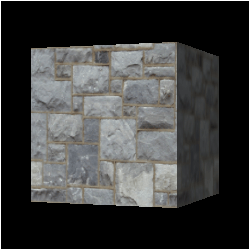
We can now render using deferred shading.
To Do Exercises
1. Compile and run the program to see a rotating cube rendered using deferred shading. Press escape to quit.
2. Create a point light deferred shader.
3. Add hundreds of point lights to the scene.
4. Look at compressing the data and using smaller/less render textures.
5. Convert some of the other shaders to use deferred shading such as normal mapping and shadows.
Source Code
Source Code and Data Files: gl4linuxtut50_src.tar.gz

